SUNLU High-Speed PLA 1.75mm Mini Spools 2kg (8x250g) Review 2026: Is it Worth It?

Quick Analysis Verdict
"Great for hobbyists and multi-nozzle users who need many colors and high-speed, small-spool printing; not for long continuous production runs or printers that require full-size spools."
Review Methodology
Why this analysis may help before you buy
Rating signal
We weigh star rating together with 762 visible reviews so a rating is not judged in isolation.
Buyer momentum
Recent purchase activity and category badges help us identify products shoppers are actively considering.
RefreshBuy score
The score combines performance, quality, value, and ease-of-use signals for this category.
Decision Guide
Is SUNLU High-Speed PLA 1.75mm Mini Spools 2kg (8x250g) a good fit for you?
For shoppers comparing 3D Printing & Scanning products, this SUNLU option looks strongest on value with a 9.0/10 signal. The main area to double-check is quality, especially if that is your top priority.
Rapid prototyping and multi-color hobby projects on multi-nozzle or open-spool printers where small spools and high-speed throughput matter most.
limited-but-useful review coverage, 4.5/5 rating, and 50+ recent monthly purchases.
Value score 9.0/10 at $50.99 current tracked price.
Choose it if
You want a 3D Printing & Scanning pick where the strongest measurable signal is value and the current review base is large enough to compare with alternatives.
Compare alternatives if
Your buying decision depends mostly on quality, long-term durability, or a lower final checkout price after marketplace changes.
Before buying
Check both Amazon Canada and Amazon US from this detail page, then compare similar 3D Printing & Scanning products below before deciding.
Rapid prototyping and multi-color hobby projects on multi-nozzle or open-spool printers where small spools and high-speed throughput matter most.
Great Value
Material stability is good when stored sealed; printed parts are durable for display and light-use prototypes, but spool hardware and PLA's thermal limits lower suitability for rugged, long-life applications.
Key Buying Points
Compact 8×250g format — mini spools (140mm diameter) make multi-color setups and 3D-pen work convenient and reduce wasted filament when testing colors.
High-Speed PLA formulation — advertised 1.5× fluidity yields smoother extrusion at faster print speeds, enabling quicker prototypes with retained surface detail.
Tight diameter control — manufacturer claims ±0.02mm tolerance and bubble-free extrusion, translating to fewer jams and more consistent dimensional prints in practice.
Improved toughness — higher impact resistance than standard PLA makes small printed parts less brittle and more drop-resistant for functional prototypes and display models.
Good surface finish — strong interlayer adhesion and glossy appearance produce visually pleasing models straight off the build plate with minimal post-processing.
Vacuum-sealed packaging — arrives dry and ready to print for most users, reducing first-use failures and limiting spool conditioning needs out of the box.
Wide printer compatibility — performs well across many FDM printers (including Bambu/Bambu Lab models in user reports) and pairs with SUNLU dryers for longer storage.
Cost-effective alternative — consistent positive reviews show it matches or approaches OEM filaments in print quality for a lower per-kg price.
The Catch
Small-spool compatibility — 140mm mini spools may not seat correctly in some enclosed AMS/chain-feed systems; adapters or different spool handling may be required.
Spool leader and hub issues — isolated reports of no pre-fed leader and weak plastic spool hardware that can loosen in automated spools (AMS) and cause unspooling.
Not a high-temperature material — despite improved impact resistance, HS PLA is still PLA-based and won't replace engineering filaments for heat or load-bearing parts.
More spool swaps for long prints — 250g spools are convenient for color variety but require frequent changes for large or continuous prints, interrupting long jobs.
Color/black depth variance — some users note slight color and tone differences between batches (notably deeper blacks), so color matching across batches may require caution.
Performance Scorecard
Common Questions & Expert Insights
Q: Will this filament clog my printer when printing at high speeds? ▼
Q: Will the 140mm mini spools fit in my printer's spool holder or AMS? ▼
Q: Is SUNLU HS PLA suitable for functional load-bearing parts? ▼
Q: Is the 1.75mm tolerance reliable enough for precision printing? ▼
Q: Can I use these spools with a SUNLU filament dryer (S1/S2)? ▼
Q: Will this filament work with Bambu Lab printers on stock settings? ▼
Q: How should I store the mini spools to prevent moisture uptake? ▼
Q: Can I dry the spools if they absorb moisture? ▼
Q: How does SUNLU HS PLA compare to generic PLA? ▼
Q: Is SUNLU HS PLA noticeably different from Bambu Lab filament? ▼
You May Also Like
Top-rated alternatives in 3D Printing & Scanning
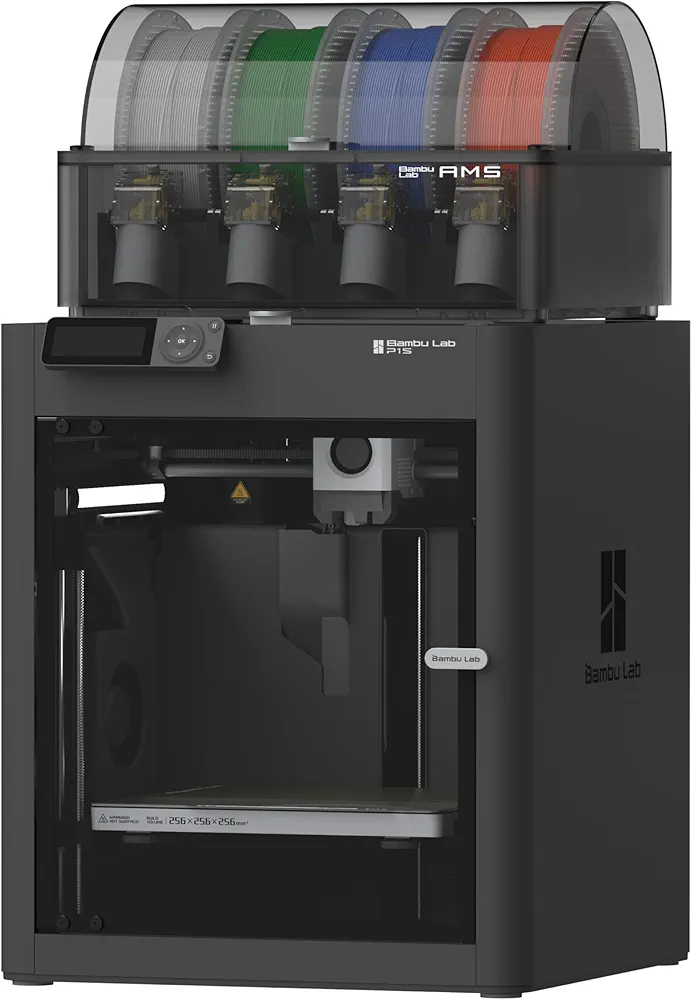
Bambu Lab P1S Combo Multicolor Enclosed 3D Printer with AMS
 Save 25%
ELEGOO Rapid PETG Filament 1.75mm 4KG High-Speed Printing
 Save 30%
 Save 37%
GIANTARM Silk PLA Filament Gold 1.75mm, 1kg, Vacuum Packed, Tough

FLASHFORGE Adventurer 5M Auto-Leveling 600mm/s 3D Printer
 Save 32%
Overture PETG Filament 1.75mm – Reliable, Clog-Free 3D Printing Filament
 Save 29%
